Showing posts with label WSDOT. Show all posts

Monday, May 21, 2012

Background on Seat Belts in Washington


Looking Back
2012 marks the 10th anniversary of Washington’s seat belt law changing from a secondary law to a primary law. That change allowed law enforcement to issue a seat belt ticket when there was no other citable traffic infraction. Also that year, Washington adopted the Click It or Ticket project that was being used in other states. In one year the use rate jumped 10 percentage points. (WTSC)

In Washington during the past ten years, 1,010 lives have been saved by drivers and passengers using seat belts. This estimate is based on an assumption that the 2001 vehicle-occupant death rate of 0.95 per 100 million vehicle-miles traveled remained constant through 2011. (WTSC)

In the past ten years, traffic deaths on Washington roadways are down 29 percent and serious injuries are down 28 percent, while vehicle-miles traveled increased 6.6 percent over this same period. (FARS, WSDOT)

Year
Number of
Traffic Deaths
Number of Vehicle Occupant Deaths
1999
637
526
2000
631
511
2001
649
509
2002
658
513
2003
600
449
2004
567
419
2005
649
476
2006
633
470
2007
571
415
2008
521
361
2009
492
348
2010
460
315
2011
*455
*304
 *Preliminary & expected to change


Timeline Notes (WTSC, NHTSA)

1986
Many states begin conducting and reporting observational seat belt surveys. By the end of 1986, 22 states had passed a seat belt law, including Washington, which passed a secondary law. That is, law enforcement officers could issue a ticket for not wearing a seat belt only when there was another citable traffic infraction. In one year, the use rate increased from 36 percent to 52 percent.

1995
Seat belt use reaches 80 percent.

2002
  • Washington conducted its first Click It or Ticket campaign, following in the footsteps of several other states.
  • Separately, the Washington Legislature passed a bill changing the seat belt law from a secondary law to a primary law. The use rate jumped 10 points from 82.6 to 92.6.
  • Washington has the highest seat belt use rate in the nation. This achievement is repeated in 2003 and 2006.
2007                                                                                           
The Click It or Ticket campaigns moved to nighttime hours as a test project for the country because the national traffic death rate at night is four times higher.

2011                                                                                           
From 2002 through 2011 the seat belt use rate increased to 97.5 percent. For the past ten years, Washington consistently has had one of the highest seat belt rates in the nation.


Seat belt tickets issued in the past 10 years
2001 - 8,504
2002 - 15,579
2003 - 15,978
2004 - 19,941
2005 - 24,179
2006 - 18,618
2007 - 24,340
2008 - 35,125
2009 - 78,495
2010 - 72,268
2011 - 68,633
Total - 381,660

In 2002 the cost of a seat belt ticket was $86. In 2012 a seat belt ticket cost $124. (AOC)


General Seat Belt Information
The medical costs of an unbuckled motorist average $11,000 more per collision than those who buckle up (HIPRC).

When motorists are unbuckled, often they are ejected partially or completely from vehicles. By wearing seat belts, they reduce their risk of being ejected by 81% (HIPRC).

When used correctly, lap and shoulder belts reduce the risk of fatal injury by 60 percent and the risk of head injury by 80 percent. (HIPRC)

Currently, the nighttime death rate in Washington is about three times (2.8) higher than the daytime rate. (FARS, WSDOT)

Compared to people who drive during the day with seat belts on, nighttime unbuckled drivers are: (WTSC)
  • Three times more likely to have felony records.
  • Twice as likely to have criminal records for offenses involving violence.
  • Three times more likely to have a DUI on their records.
  • More than twice as likely to have a negligent or reckless driving violation on their driving records.

The seat belt law is a primary-enforcement law in Washington, so an officer can pull over a vehicle if a driver — or passenger — is not buckled up. If the unbuckled passenger is under age 16, the driver gets the ticket; if unbuckled passengers are age 16 or older, they get their own seat belt tickets. (RCW 46.61.688)

Source Key
FARS - Fatality Analysis Reporting System
WTSC - Washington Traffic Safety Commission
WSDOT - Washington State Department of Transportation
RCW - Revised Codes of Washington
HIPRC - Harborview Injury Prevention Research Center
AOC - Administrative Office of the Courts (Washington’s)

Source: King County Traffic Safety Task Force

Friday, April 1, 2011

Safer Roadways Paved by the Recovery Act

In the first two years of the American Recovery and Reinvestment Act, construction crews across Washington preserved 820 lane miles of rural and urban highways and upgraded 879 miles of roadway to reduce the risk of serious collisions.

These are just two of the investments outlined in a Washington State Department of Transportation report on the state's delivery of Recovery Act-funded projects. The report – WSDOT and the American Recovery and Reinvestment Act – documents how WSDOT worked with its partners in local government and private construction companies to deliver transportation improvements across the state.

State and local governments have completed 185 projects and spent more than $400 million of the $490 million in Recovery Act highway funds distributed to Washington. In addition, the state has received $781 million in federal high-speed rail funds and $179 million in transit funds as part of the Recovery Act.

The analysis is part of WSDOT's ongoing effort to assess state and federal investments in transportation and comes at a transition point for Washington's Recovery Act project delivery. Most of the highway, transit, and ferries projects are now complete, while construction is about to begin on the agency's Recovery Act-funded high-speed rail program.

Thursday, February 24, 2011

Plan for Weather & Road Conditions

Drivers across the state can plan for weather and road conditions by utilizing Washington State Department of Transportation Web and mobile tools and local media reports.

The National Weather Service reports the significant winter storm that started today with snow should continue through Friday. Drivers can expect freezing temperatures and snow throughout the state and strong winds near the Canadian border.

WSDOT's online tools include:
Traffic cameras
Travel alerts
Mountain passes
Traffic products for mobile phones and other wireless devices
WSDOT Twitter feed

Real time traffic information is also available by calling 5-1-1.

Friday, September 3, 2010

Holiday travel safey tips

...with a little help from WSDOT...
Today, many of us will hit the road to begin our Labor Day Holiday. While the roadway and driving safety hazards seem to remain the same year to year, as we approach one of the deadliest travel weekends of the year, it is always a good idea to review safe procedures before you leave. Last year's Labor Day blog post provides drivers with a few great tips.

In addition, a great way to be aware of traffic issues is WSDOT's new mobile application for iPhone and Android which delivers timely travel information.

With the Labor Day holiday approaching, the Washington State Department of Transportation has made it even easier for smart-phone users to "know before you go." Smart phone users will have access to WSDOT's travel information including:
  • Canadian border wait times
  • Ferries – schedules, travel alerts and routes
  • Flickr photos
  • Mountain passes
  • Seattle traffic cameras
  • Travel times for Puget Sound highways
  • Twitter
  • WSDOT Blog

To access these apps, just search for "WSDOT" in the Android Market or in the iTunes App Store. For those who don't have access to the new mobile application, information also is available on WSDOT's website or by calling 5-1-1.

Wednesday, August 25, 2010

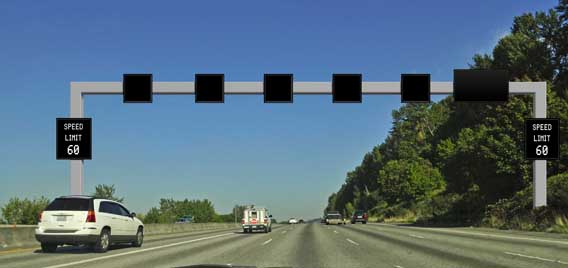
Smarter Highways: What do you think?

Contributed by Sandy Paquette, Roadway Safety Trainer, Evergreen Safety Council

Washington State Department of Transportation has the new sign bridges on I-5 in operation.

Here is the sign progression:
Mile 1: When traffic flows freely, the variable speed limit signs are black
Mile 1.5 Seconds after a collision occurs three miles up the highway, the speed limit drops and a sign warns drivers of backups ahead
Mile 2: As vehicles approach the collision area, the speed drops again.
Mile 2.5: A mile from the trouble spot speed limit signs flash arrows intermittently. Green arrows instruct drivers to proceed in their lane, and yellow arrows mean exit the lane as soon as safely possible, because the lane is closed or blocked ahead.
Mile 3: At the site of the collision, red X’s indicate which lanes are blocked.

Monday, January 18, 2010

High-Visibility Safety Apparel

By Sandy Paquette, Trainer, Evergreen Safety Council

The American National Standard for High-Visibility Safety Apparel and Headwear (ANSI/ISEA 107-2004) is a standard established by the American National Standards Institute, Inc.

Before the first publication of this standard in 1999, there was no regulation or specific guideline for the design and performance of materials for high visibility safety apparel in the U.S. Since 1999, private industries as well as various federal, state, and local authorities have recognized the ANSI/ISEA 107-1999 standard.

Historically, the Manual on Uniform Traffic Control Devices MUTCD (by the U.S. Department of Transportation - Federal Highway Administration) focused on visibility from the driver’s perspective: the use of traffic cones, drums, and signs to provide motorists with visual cues and clear channels of travel. Until the release of the 2003 edition where the ANSI 107-1999 was first introduced as a standard, the MUTCD provided only general guidelines for workers visibility in work zones.

The guidelines introduced in the 107-1999 standard have since become more explicit in the new 107-2004 standard. The American National Standard Institute, Inc. has broken down these specific guidelines into classes, and parameters that need to be addressed. These parameters include design, requirements for background and combined-performance for retro-reflective materials, photometric and physical performance requirements for retro-reflective materials and care labeling.

There are three distinct performance levels:
Class 1 – Apparel for the use in activities that permit the wearer’s full and undivided attention to approaching traffic. Ample separation of workers from traffic and speeds do not exceed 25 MPH.

Class 2 – Apparel for the use in activities where greater visibility is necessary during inclement weather or work in environments higher risks. Workers who perform tasks that divert their attention form approaching traffic or those with proximity to passing vehicles require a minimum of class 2. Class 2 is Washington State’s minimum for hours of daylight for flaggers.

Class 3 – Apparel for the highest level of visibility for workers facing serious hazards and/or high task loads that require attention away from their work. Garments cover more of the body, such as arms and legs to differentiate the worker from inanimate objects such as cones and other traffic control devices.

The combination of the Class2 garment and Class E pants equals a Class3 ensemble.

New regulations for high visibility apparel went into affect on November 24th of 2008
The Federal regulation CFR 634 states that “all workers” (including towing companies, emergency first responders, media and law enforcement) within the right-of-way of a Federal-aid-highway who are exposed either to traffic or construction equipment within the work area SHALL wear high visibility safety apparel meeting Class 2 or Class 3. Since there are 975,000 miles of Federal-aid-highways it is extremely difficult to determine what is and isn’t “Federal-aid” so, many employers are opting to assume that all roads are covered under the regulation to avoid inadvertent noncompliance.

Tuesday, September 22, 2009

HIGHWAY FATALITIES LOWEST SINCE 1955

This morning the Washington State Patrol distributed a joint news release, collaboratively developed by WSP, the Washington State Department of Transportation and the Washington Traffic Safety Commission: Highway Fatalities Lowest Since 1955—Deaths trending steadily toward “Target Zero” goal.

(Olympia)—Traffic fatalities in Washington have hit their lowest level since 1955, according to new data from the Washington Department of Transportation and the Washington Traffic Safety Commission. The news is encouraging to state officials who are working toward “Target Zero,” the goal of having zero traffic-related fatalities or serious injuries by 2030.
To date, 522 deaths have been reported for 2008. That’s the lowest since 461 people died in 1955. The 2008 count will not be final until Dec. 31, and it’s possible a small number of delayed reports could still be received.

At least some of the good news is attributed to increased usage of seat belts. The number of deaths in which the victim was unbelted has dropped by more than a third since 2000.
“We have been strictly enforcing the state’s seat belt law, and that appears to be paying dividends,” said Washington State Patrol Chief John R. Batiste. “There’s no simpler way to protect yourself from ‘the other driver’s mistake’ than to buckle your seat belt.”

Washington has a 96.5 percent seatbelt usage rate, third-highest in the nation. Only Michigan and Hawaii have higher seatbelt use rates.

Along with enforcement, the other three components of Target Zero are education, engineering and emergency medical services.

The Washington Traffic Safety Commission funds extra enforcement through grants to law enforcement agencies. The Commission also funds educational outreach, sometimes including radio or TV ads that alert drivers to ongoing patrols.

“To reach Washington’s goal of zero traffic deaths we need to use proven strategies,” said Lowell Porter, Director of the Washington Traffic Safety Commission. “Combining enforcement with education is just that—a proven strategy that moves the needle toward fewer traffic deaths.”

The engineering component of Target Zero involves occupant protection built into vehicles, and highway engineering. Well-engineered roads reduce fatalities by being more forgiving of driver error.

“We all see these trends as very encouraging and believe, with drivers’ help, we can meet our Target Zero goal,” said Secretary of Transportation Paula Hammond. “Safety is our priority when we build, improve and maintain roads. We are committed to reducing collisions, one of the leading causes of congestion."

Chief Batiste also praised emergency medical responders for their success in the Target Zero effort.

“My troopers are witnessing miracles at the side of the road,” Batiste said. “Paramedics are saving people who just a few years ago would have certainly become statistics. We marvel at their ability to pull injured people back from the brink of death.”

There was initial concern that the recent sharp drop in fatalities might have been solely caused by a reduction in driving attributed to high gasoline prices and the recession. However when agencies measured the number of fatalities against total miles driven the news remained good. “Fatality Rate” is the number traffic deaths per 100 million vehicle miles traveled (VMT.)

Washington’s traffic fatality rate in 2008 was .94 (point-94) deaths per 100 million VMT. That’s down slightly from 1.00 in 2007, and about half the 1990 rate of 1.85 deaths.
Not only are there fewer deaths, but the number of collisions is also trending down. In 1990 there were nearly 2,500 fatal or serious injury collisions. By 2008, that number had dropped to just over 1,000, even though miles traveled increased by about a third.

All three officials were quick to caution that there could be bumps in the statistical road ahead. They warned against getting too alarmed, or too excited, by any individual year. All three will monitor long-term trends to determine if adjustments are needed in order to reach the goal of Target Zero.

Contacts
Sgt. Freddy Williams, WSP, (360) 596-4014
Alice Fiman, WSDOT, (360) 705-7080
M.J. Haught, WTSC, (360) 725-9879