Showing posts with label Safety Health Specialist. Show all posts

Tuesday, December 20, 2011

Workplace Accident - What do we do now?

Contributed by Norm Nyhuis, Trainer / Consultant

Five words that strike fear into any business operator’s heart (besides “60 Minutes is waiting outside”) are certainly, “We’ve just had an accident.” Keeping employees safe is of primary concern to any employer, but in spite of our best efforts, undesirable events with negative results still happen.

When an accident occurs, a business should approach the investigation with the thought in mind of, “what can we learn for this event that will help us avoid a similar event in the future?” Our focus should be on preventability.

Businesses need to investigate not only accidents that occur, but also investigate those events where no one was injured, but were accidents none the less. Why? Every event that we could call a “near miss” should be seen as a free warning, to induce us to take whatever measures apply to prevent a more serious event from happening.

Take for example a worker who is assigned to change a burned out light bulb, over a windowless, side door to the building. The worker is only going to be a couple of rungs up the ladder, and only for a few moments, so doesn’t take the time to put a warning sign on the other side of the door. While removing the fixture’s cover to access the bulb, another worker opens the door from the inside. Fortunately, the guy changing the light bulb had just climbed down, and wasn’t actually on the ladder at the moment the door was opened and the ladder was tipped over, but what if. . . . .

This event should be seen as a reminder that when ever working in an area where there is expected to be other workers passing through, we always should set up either warning signs or even temporarily barricade, restricting access to the area, until the work is finished.

Following are some of the reasons why the four basic steps listed should be taken, following an accident, and in the order presented:

Immediate actions: For most of us, a call to 9-1-1 is the first priority – get trained help on the way. Determine if the scene is safe for responders to enter, then address the first aid needs of any who were injured. Also determine if the scene can be isolated, preventing the possibility for the damage to spread. A second reason to isolate the scene is to prevent things from being moved or disturbed. Examination of the evidence left behind can often tell the investigator what happened; if things are moved or debris is cleaned up, a piece of the story may be gone and not be able to be recaptured.

Determine the facts: No one will be able to tell you everything that happened, so you will have to get pieces of the story from various sources. Interview witnesses, and if able, interview the person(s) directly involved. Take your own notes, photographs, and even draw a sketch of the area. NOTE: sketches are not to scale and should be so noted on the sketch, but do show the general relationship and location of objects and personnel at the time of the event. Paper documentation may also help: things such as time sheets, training records, and maintenance records may reveal contributing factors to the cause of the event.

Establish causes: Once all the data is gathered and evaluated, the cause can usually be identified. Remember – accidents seldom have a single cause, but are usually the result of several contributing factors, all coming together at the wrong time. Keep in mind the goal in this step is to establish the cause(s) and learn how to prevent those factors from coming together again.

Recommend and implement corrective actions: Once the determination has been made as to what factors came together to cause the event, take steps to reduce or eliminate the possibility of a reoccurrence. This may include

• Eliminating the process altogether
• Substitute a less hazardous item or chemical for the more dangerous one An example would be use a non-flammable solution for parts cleaning rather than a flammable petroleum product.
• Isolate the hazard that precipitated the event, such as enclose the item in an area where people can not come into contact with it, or be affected by it (such as enclosing a noisy machine in an insolated room).
• Engineering controls; such as a change to equipment, a change to eliminate the need for human intervention to control the process. Add guards, or interlocks to prevent a human operator from placing their hands in the operational part of the machine.
• Administrative changes: change operating procedures or company safety policies, for example to insure that no one works alone in a particularly hazardous area. Paint lines around a machine and require that only the operator be “inside the line” while the machine is in operation.
• PPE. As a last line of defense, what PPE should be worn by the employee when performing the task in question? Was the employee aware of the PPE need? Was the employee trained in the use and care of the PPE?
We must take the time to learn from seemingly inconsequential everyday events, and take the appropriate actions indicated to prevent accidents before they happen.

Evergreen Safety Council offers a class on Accident Investigation as part of our Safety & Health Specialist series.  Have an issue you would like address now? ESC can come to your location and perform an investigation for you.

Friday, October 28, 2011

Survey results indicate upcoming safety professional shortage

Contributed by Star Conrad, Director of Operations, Evergreen Safety Council 
Demand for occupational safety and health services will soon exceed the supply of trained and experienced professionals, according to results from a new NIOSH survey.

The national survey (.pdf file), commissioned by NIOSH in 2008 and performed by an independent firm, found that employers plan to hire at least 25,000 safety and health professionals over the next five years, but less than 13,000 new graduates are expected from academic programs. In addition, NIOSH said many of the projected vacancies likely will be filled by current employees or workers without occupational safety and health training.

The need for more trained professionals is especially great given the pending retirement of older safety professionals and new technologies that require specialized skills and knowledge, NIOSH Director John Howard said in an agency press release.


Other survey results include:
• Degree programs in occupational safety and health have experienced declines in university funding, especially those not funded through NIOSH.
• Employers want new graduates to have training in leadership and communication.

Are you looking to move into a Safety & Health career?  Evergreen Safety Council's Safety & Health Specialist certification series, as well as our more advanced Health & Safety Technician certification series can help.  Call or email Stephanie Dyck 800-521-0778 for more information and to request an information pamphlet today.

Monday, January 10, 2011

Presentation Skills for Effective Safety Communications

Do you provide training for your employees? Have to give presentations as part of your job? Do you wish you were more comfortable when standing in front of a group?

Here's a funny, 2-minute video just to make you laugh. (Yes, a "competitor" made it.) Feel free to share if you've ever done anything like this as a presenter. We can all learn from each others experiences.

Evergreen Offers a Presentation Skills for Effective Safety Communications course twice a year as part of the Safety & Health Specialist series. The next class is on January 27th. Register today, and be ready for the next time you need to make a presentation. Class size is limited to allow for group participation.

This workshop allows participant to practice effective stand-up and round-table speaking and presentations. Effective presentation principles are covered, including exercises and critiquing presentation effectiveness and style. Some materials are sent out prior to the class.

Thursday, July 22, 2010

Do you need to be an effec­tive train­er, pre­sen­ter or facil­i­ta­tor?

I do not like standing up in front of a crowd, but seated at a table I can present my ideas just fine. Why is that? I know lots of people on both sides of the “speaker” spectrum, and they all say/need the same thing: practice, practice, practice.

Participants in our Presentation Skills course learn to speak/present more effectively in a stand-up or round-table environment. This interactive class includes the basic principles of effective presentations, such as:
  • style
  • how to prepare and rehearse
  • how to com­mu­ni­cate clearly and per­sua­sively with management, cus­tomers and employees
  • the importance of audience interaction
  • how to respond constructively to questions
  • how to deliver engag­ing train­ing ses­sions, workshops and meeting presentations

Are you a sub­ject mat­ter expert who needs to share your knowledge with management or staff? This course will help you develop skills as a facil­i­ta­tor to run effec­tive and pro­duc­tive meet­ings – even in highly charged conditions.

This workshop allows participant to practice a variety of presentation styles, and includes critiquing presentation effectiveness and style.

Class size is limited to allow for group participation, and space is still available. The next class is Thursday, July 29th – Register today!


Becoming a Safety & Health Specialist
This course is part of ESC’s Safety & Health Specialist certification program, which is designed to provide participants with a solid foundation of knowledge in safety-related skills and activities. Each participant learns the state and federal health and safety regulations affecting all organizations. Successful completion of the entire training series prepares the participant to perform basic safety and health duties for the employer with confidence.

The SHS program consists of 22 safety and health topics, taught in 15 training sessions. Each session is one day in length, covering one or two subjects. Classes are open to everyone without prerequisites or commitment to the total program. You can simply attend the classes that interest you, or complete the entire series to be certified as a Safety and Health Specialist.

Wednesday, May 26, 2010

Situational Safety

Contributed by Norm Nyhuis, Trainer, Evergreen Safety Council

Wander back with me, for just a moment, to your years as a student. . . all of us can remember how tough it was to sit in the classroom, when the first warm days of early spring called to us through the prison bars we were sure we saw on the school room windows. How can we concentrate on split-infinitives, quadratic equations, or even coloring while staying between the lines, when spring time activities beckon? But wait; what’s this? The teacher is leaving the room . . . now is the time to entertain the class by demonstrating that you can stick your head in the opening between the chair seat and backrest. Everyone is laughing and enjoying your show, but now it’s time to get back in the seat, and the teacher will be none the wiser . . . . .

Now fast-forward to after the teacher has returned to the room to find you in this embarrassing situation. To add insult to the situation, let’s call the school nurse, and one or two of the school maintenance staff to saw the chair apart to extract your head. Wonder if my parents will get a bill for the damaged chair?

Kid-stuff prank, you say? Hopefully this boy grew up to be a productive citizen, but let’s face it, even adults do some pretty silly things at times, that cause us to only shake our heads and wonder what they were thinking. Ahh . . . maybe, just maybe, they weren’t thinking!

Accident prevention is every employees’ responsibility, and avoiding horseplay, on the job is just one area where what seemed innocent at the start, can otherwise turn quickly to a tragic event.

Evergreen Safety Council offers a certification series of training for Safety and Health Specialists, where accident prevention is a common thread through all of the training sessions. If you have an interest in obtaining this certification, contact ESC at (800) 521-0778 or via the links on this web-site to learn more about this, and all the workplace safety programs we offer.
Picture source: the Navy Safety Center

Wednesday, April 28, 2010

Proper work flow leads to better safety

Contributed by Norm Nyhuis, Trainer, Evergreen Safety Council
There’s an old joke about two workers along the side of the road. The first was digging a series of holes with a shovel, and following behind him, another worker was filling in the holes. When asked what they were doing, one worker explained that usually there were three on crew, and their job was to plant trees along the road side. However on this day, the second person in the crew, the one who actually placed the trees in the holes, was off on sick-leave. “Just ‘cause George isn’t here today, that don’t mean we can’t do our jobs!”

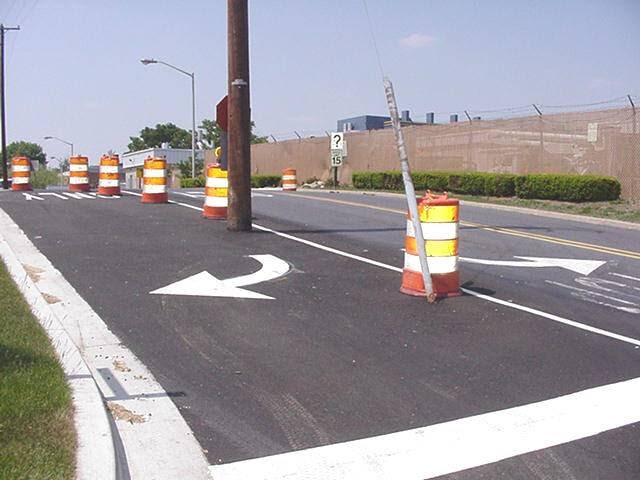
Yes it’s a corny story, but how many times do we go ahead with a task, taking an obvious risk, because the preliminary work is not completed, and perhaps put ourselves or others at risk when we do so? The following photo is a case in point.
Apparently, the road bed preparation, of this road widening project was finished and the paving crew was ready to go, and the paint-stripping crew wanted to take advantage of the sunny weather to get the lane marking completed, too . . . . . but the utilities company hadn’t yet gotten a crew out to relocate the pole. At least the hazard is marked with barrels, but barrels often get “bumped” out of the way, leaving this all too solid and unmoving utility pole in harm’s way.

Before you start a task, take a moment to list the others who may be affected by your work. Is someone else being put at risk, if you were to go out-of-sequence or skip a step in the process?

Following the proper work flow sequence is a major component of several of Evergreen Safety Council’s series of courses comprising our Safety & Health Specialist certification. If you have an interest in supporting safe work practices for your company, and want to have a better understanding of the spectrum of safety concepts of which you should be aware, contact us or check our the Safety & Health Specialist option on our website.